
 Facebook
 X
X
 Pinterest
 Copy Link
Sarasota has become one of Florida’s most sought-after relocation destinations, and it is not difficult to understand why. Consistently ranked among the best places to live and retire in the United States (including a #4 ranking in U.S. News & World Report’s Best Places to Retire in 2024), the city offers a rare combination of world-class beaches, a sophisticated arts and cultural scene, excellent healthcare, and a warm, welcoming community atmosphere. Yet for all its appeal, living in Sarasota is a fundamentally different experience from visiting on vacation.
The relocation buyers who thrive here are those who arrive informed. They understand the financial realities, have explored the distinct personalities of each neighborhood, and have a clear sense of the lifestyle they are seeking. Those who struggle are often the ones who fell in love with a property before falling in love with a community.
This post is designed to bridge that gap. Drawing on current market data, local expertise, and a thorough understanding of the Sarasota area, it covers everything a relocation buyer needs to know before making the move to Florida’s Cultural Coast.
Why People Move to Sarasota
Sarasota’s popularity as a relocation destination is not a recent phenomenon, but the pace of inbound migration has accelerated considerably over the past several years. A combination of lifestyle, financial, and quality-of-life factors makes the city compelling to a remarkably diverse range of buyers, from young families and remote professionals to retirees and second-home seekers.
World-Class Beaches
The beaches are, for many, the single greatest draw. Siesta Key Beach has been ranked the number one beach in the United States multiple times by the respected Dr. Beach ranking system, celebrated for its powder-soft quartz crystal sand and the clarity of its Gulf waters. Unlike the coarser, shell-mixed sands found along much of Florida’s coastline, Siesta Key’s quartz composition stays cool underfoot even on the hottest summer days, a detail that impresses first-time visitors and long-time residents alike.
Beyond Siesta Key, the Sarasota area offers a remarkable variety of beach experiences. Lido Key provides a quieter, more refined atmosphere with easy access to the boutique shops and fine dining of St. Armands Circle. Longboat Key stretches twelve miles of largely uncrowded shoreline, offering the kind of privacy and tranquility that is increasingly rare on Florida’s Gulf Coast. Venice Beach, further south, is famous as the “Shark Tooth Capital of the World” and draws fossil hunters and families year-round. Each beach has its own character, and many residents find themselves rotating between them depending on their mood and the season.
Florida’s Cultural Coast
Sarasota carries the title of Florida’s Cultural Coast with genuine distinction. The city’s arts and cultural infrastructure is extraordinary for a metropolitan area of its size, offering experiences that are typically found only in major cities.
The legacy of John Ringling, the circus magnate who made Sarasota his home in the early twentieth century, is the foundation of much of this cultural wealth. His estate, The Ringling, encompasses a world-class art museum housing an impressive collection of European Old Masters, a Venetian Gothic mansion known as Ca’ d’Zan, a circus museum, and expansive gardens overlooking Sarasota Bay. Beyond The Ringling, the city is home to the Sarasota Opera, the Sarasota Ballet, the Sarasota Orchestra, the Florida Studio Theatre, and the Asolo Repertory Theatre, all professional companies offering year-round performances of the highest caliber.
The visual arts scene is equally vibrant. The Towles Court Artist Colony, the Burns Square district, and the Rosemary District feature galleries, studios, and monthly art walks. Annual events such as the Sarasota Film Festival, the Chalk Festival, and the Sarasota Music Festival bring international talent and visitors to the city throughout the year.
For those who value cultural engagement as part of their daily life, Sarasota delivers in a way that few cities of comparable size can match.
An Active, Outdoor Lifestyle
Sarasota’s year-round sunshine, the city averages approximately 251 sunny days per year — makes an active, outdoor lifestyle not just possible but practically irresistible. The Gulf of Mexico and Sarasota Bay provide endless opportunities for boating, fishing, kayaking, paddleboarding, and sailing. Multiple marinas, boat clubs, and rental facilities make getting on the water accessible for residents at every level of experience.
On land, the Legacy Trail offers more than 20 miles of paved trail for cycling, walking, and running, connecting Sarasota to Venice through a scenic corridor of natural landscapes. The area is also a golfer’s paradise, with over 30 courses ranging from municipal layouts to exclusive private clubs like TPC Prestancia, The Oaks, and Laurel Oak. Pickleball, which has exploded in popularity across the country, has found a particularly enthusiastic following in Sarasota, with dedicated courts and organized leagues throughout the county.
Healthcare Excellence
For retirees and those with families, the quality of local healthcare is a critical consideration. Sarasota consistently performs well on this front. Sarasota Memorial Hospital, an 839-bed regional medical center, is consistently ranked among the best hospitals in Florida and the nation. The region offers strong access to primary care and specialist physicians across most disciplines, a direct result of the area’s desirability attracting top medical talent. The large and growing retiree population has also driven the development of outstanding geriatric care, rehabilitation services, and continuing care communities.
Financial Benefits of Florida Residency
Florida’s financial advantages are a significant and often underappreciated driver of relocation. The state levies no state income tax, which can result in substantial annual savings for high earners, retirees drawing on investment income, and anyone relocating from high-tax states such as New York, California, or New Jersey. For some buyers, the tax savings alone can be enough to offset higher housing costs.
Additionally, Florida’s Homestead Exemption provides meaningful property tax relief for primary residents. The exemption removes $65,000 from the assessed value of a home for property tax purposes, and the associated Save Our Homes cap limits annual increases in assessed value to 3%, a powerful protection against rising property taxes in a market where values have appreciated significantly.
What Surprises New Residents
For all its appeal, Sarasota is not without its challenges. The buyers who make the most successful transitions are those who arrive with a clear-eyed understanding of what life in a subtropical coastal city actually involves.
The Summer Climate
The most common adjustment for newcomers is the summer climate. From June through September, Sarasota is hot, humid, and prone to daily afternoon thunderstorms. Temperatures regularly reach the low 90s, and the combination of heat and humidity can make it feel significantly hotter. For those relocating from the Northeast, Midwest, or Pacific Northwest, this can be a genuine culture shock.
The practical advice from long-time residents is consistent: visit Sarasota in August before you commit to buying. If you can tolerate the heat and humidity at their peak, you will love the other nine months of the year. Most residents adapt by shifting their outdoor activities to the early morning and evening hours during the summer, and by embracing the air-conditioned indoor lifestyle that the season demands.
Insurance Costs
Insurance is the financial reality that catches the most buyers off guard. Florida has some of the highest homeowners insurance premiums in the country, and Sarasota is no exception. Annual premiums for a standard policy can run into several thousand dollars, with the exact cost varying significantly based on factors such as flood zone designation, roof age and material, proximity to the water, and the presence or absence of impact windows and hurricane shutters.
It is critical to understand that a standard homeowners insurance policy typically covers wind-related damage but does not include flood coverage. Flood insurance is a separate policy, often purchased through the National Flood Insurance Program (NFIP), and is required for properties in designated flood zones. Buyers should obtain insurance quotes before committing to a purchase, as the cost can materially affect the overall affordability of a property.
Hurricane Season
Sarasota sits within Florida’s hurricane belt, and hurricane season runs from June through November, with September typically being the most active month. New residents should familiarize themselves with their property’s evacuation zone (designated A through E by Sarasota County), build an emergency preparedness kit, and review their insurance coverage annually. Many communities have well-established neighbor networks that help prepare homes when owners are away during storm events.
Seasonal Crowds and Traffic
Sarasota’s population swells significantly during the winter and spring months as seasonal residents, commonly known as “snowbirds” — arrive from colder northern states and Canada. This influx brings a welcome energy to the city’s restaurants, cultural venues, and social scene, but it also means noticeably heavier traffic, longer wait times at popular restaurants, and more crowded beaches from roughly January through April.
Key corridors such as US 41, Fruitville Road, and the bridges connecting the mainland to the barrier islands can become congested during peak season. Public transportation in Sarasota is limited, and the vast majority of residents rely on personal vehicles for daily errands and commuting. Buyers should factor this into their neighborhood selection, particularly if proximity to work or specific amenities is a priority.
The Cost of Living
Sarasota is not an inexpensive place to live. The overall cost of living is approximately 14% above the national average, with housing costs running considerably higher than U.S. norms. Many communities carry HOA (Homeowners Association) fees and, in master-planned communities, CDD (Community Development District) fees that can add hundreds of dollars per month to the cost of ownership. Buyers should factor these ongoing costs into their budget calculations from the outset.
A Guide to Sarasota’s Neighborhoods
One of the most important decisions a relocation buyer will make is choosing the right neighborhood. Sarasota’s communities are remarkably diverse, each with its own character, price point, and lifestyle offering. The following overview covers the most popular areas for relocation buyers, drawing on current market data.
Downtown Sarasota
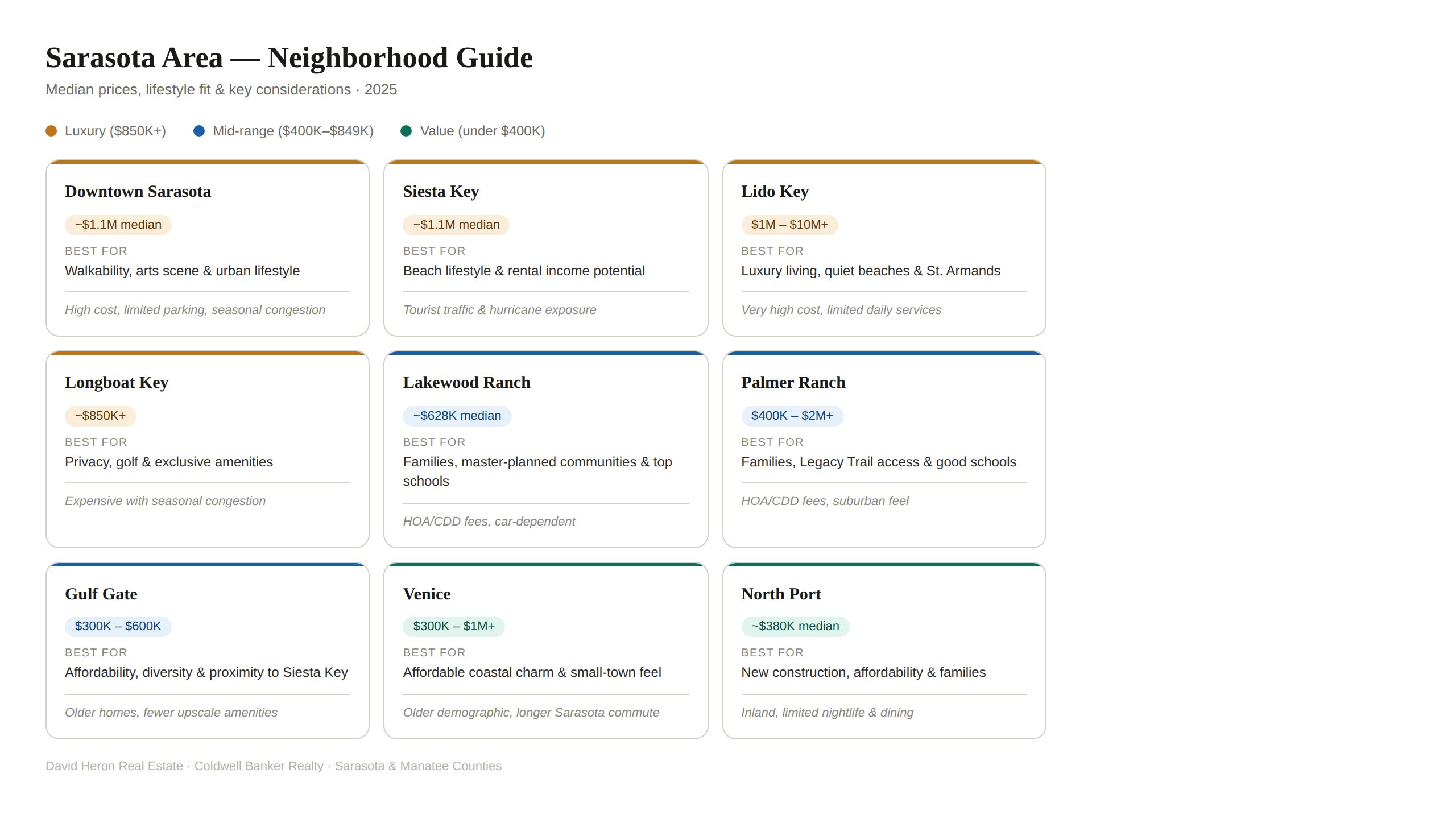
Downtown Sarasota is the cultural and social heart of the city, offering a vibrant, walkable urban lifestyle that attracts professionals, empty nesters, and retirees who want to be close to the action. Residents enjoy immediate access to Bayfront Park, the weekly Farmers Market, Marina Jack, and world-class arts venues. The housing market spans a wide range, from historic bungalows to multimillion-dollar bayfront condos, with a median home price of approximately $1.1 million as of mid-2025 . The median age of Downtown residents is 63, with an average household income of $117,000, reflecting a mix of affluent retirees, professionals, and seasonal residents.
Lakewood Ranch
Lakewood Ranch is one of the top-selling master-planned communities in the United States, and its appeal to relocation buyers is easy to understand. With a population of approximately 72,000 and a median age of 53, it offers a self-contained lifestyle hub with 150 miles of trails, multiple golf courses, tennis and polo facilities, and lively town centers that host events and farmers markets year-round. The school district is a major draw for families, with A-rated public schools and a variety of charter and private options. The median home price was approximately $628,000 in mid-2025, with a range from $400,000 townhouses to multimillion-dollar estates.
The trade-offs are worth understanding. Lakewood Ranch is car-dependent, there is no meaningful public transit, and most daily errands require driving. HOA and CDD fees are a fact of life in most communities within the Ranch, and ongoing construction in newer villages can be a source of noise and disruption for some residents.
Siesta Key
Siesta Key is the quintessential Florida beach community. Laid-back, picturesque, and anchored by the world-famous beach that draws visitors from around the globe. With a population of approximately 5,700 and a median age of 66, the island skews toward retirees and second-home owners. The housing market ranges from $800,000 cottages to $10 million-plus waterfront estates, with condos typically priced between $600,000 and $3 million. The strong short-term rental market makes Siesta Key attractive for investors, though buyers should carefully review local rental regulations before purchasing with that intent.
The island’s popularity is also its greatest challenge. During peak season and summer weekends, traffic on the single bridge connecting Siesta Key to the mainland can be severe, and parking near the beach is notoriously difficult.
Gulf Gate
For buyers seeking an affordable entry point into the Sarasota market without sacrificing proximity to the beach, Gulf Gate offers a compelling alternative. Located just minutes from Siesta Key, the neighborhood is known for its eclectic, international character — a diverse mix of residents, independent restaurants serving cuisines from around the world, and a relaxed, unpretentious atmosphere. Homes in Gulf Gate typically sell for between $300,000 and $600,000, with condos and duplexes starting lower. Many of the homes are older and may require updating, but the neighborhood’s character and location make it a popular choice for buyers who prioritize value and community over new construction.
Palmer Ranch
Palmer Ranch is a large, master-planned community located in south Sarasota, offering suburban convenience with quick access to both the beaches and the Legacy Trail. It is a popular choice for families, thanks to highly rated schools including Ashton Elementary, Sarasota Middle, and Riverview High School. Homes range from $400,000 to over $2 million, with condos and villas available at lower price points. Like Lakewood Ranch, Palmer Ranch carries HOA and CDD fees, and the community is largely car-dependent.
Venice
Venice offers a distinct alternative to the bustle of Sarasota proper. With its Italian-inspired architecture, charming downtown, and slower pace of life, Venice appeals to buyers seeking an affordable coastal lifestyle with a strong sense of community. The city’s schools are A-rated, its beaches are beautiful (and far less crowded than Siesta Key), and its downtown area features boutique shops, dining, and a historic theater. The trade-offs include a somewhat older demographic, a subdued nightlife scene, and a longer commute to downtown Sarasota. Home prices range from $300,000 to over $1 million, making it one of the more accessible markets in the broader area.
North Port
As Sarasota County’s fastest-growing city, North Port offers the most affordable housing in the region, with a median home price of approximately $380,000 and an abundance of new construction. It is a family-oriented community with a younger median age of 48, spacious lots, and attractions such as Warm Mineral Springs, Myakka State Forest, and CoolToday Park (the spring training home of the Atlanta Braves). The trade-offs are its inland location, greater distance from the beaches, and a more limited dining and nightlife scene compared to Sarasota proper.
The Sarasota Real Estate Market: What Buyers Need to Know
The Sarasota real estate market has undergone a significant transition since the peak of the post-pandemic boom. After years of rapid price appreciation and intense competition, the market has shifted toward a more balanced dynamic that is, in many respects, more favorable for relocation buyers.
According to year-end 2025 data from the REALTOR® Association of Sarasota and Manatee, the single-family home market in Sarasota County posted 9.3% growth in closed sales (reaching 8,183 transactions), while the median sale price declined by 6% to $474,700. Inventory has expanded, and the median time on market for a single-family home reached 99 days, a significant increase from the frenzied pace of the pandemic years. Sellers are now receiving approximately 93% of their original list price, indicating that there is meaningful room for negotiation.
The condo market tells a different story. Condo and townhouse sales in Sarasota County declined by 4.3% in 2025, and the median condo price fell by a more substantial 15.3% to $325,000. This correction has been driven in part by new inspection requirements and reserve funding mandates introduced in the wake of the Surfside building collapse, which have increased operating costs for many condo associations and prompted some owners to sell. Buyers considering condos should conduct thorough due diligence on the financial health of any association, including reviewing reserve studies, pending special assessments, and the association’s insurance coverage.
Practical Tips for Relocation Buyers
Purchasing a home from out of state presents unique challenges, but the Sarasota real estate community has adapted well to serve remote buyers. Virtual tours, electronic contracts, and remote closings have become standard practice, allowing buyers to complete much of the process from their current location. That said, experienced local professionals consistently advise buyers to visit in person before closing — ideally during different times of day and at different points in the season — to get a true sense of neighborhood character, noise levels, and traffic patterns.
Education: A Strong Foundation for Families
Families relocating to Sarasota will find a school district that consistently earns high marks. The Sarasota County School District has maintained an A-rating from the Florida Department of Education for nearly two decades, a remarkable achievement that reflects the quality of its teachers, programs, and leadership.
Standout public school options include Pine View School, a nationally recognized magnet school for gifted students; Riverview High School, which offers an International Baccalaureate program; and Sarasota High School, known for its Visual and Performing Arts curriculum. For families seeking private education, options include Cardinal Mooney Catholic High School, The Out-of-Door Academy, and Sarasota Military Academy, among others.
Higher education is well represented in the area. New College of Florida is a highly ranked public liberal arts institution located on a beautiful bayfront campus. Ringling College of Art and Design is internationally recognized for its programs in digital animation, game design, and illustration. USF Sarasota-Manatee offers a range of undergraduate and graduate programs as part of the University of South Florida system.
Practical Steps for a Smooth Relocation
Moving to a new state involves a number of administrative tasks that new residents should address promptly. Florida requires new residents to obtain a Florida driver’s license within 30 days of establishing residency, and vehicles must be registered within 10 days of becoming employed, placing children in school, or establishing residency. Voter registration can be completed online through the Florida Department of State website.
One of the most important early tasks for homeowners is applying for the Homestead Exemption. Applications must be filed by March 1 of the year following your purchase, and the exemption applies only to your primary residence. Filing promptly ensures you receive the maximum tax benefit and locks in the Save Our Homes assessment cap from the earliest possible date.
New residents should also take the time to familiarize themselves with Sarasota County’s emergency management resources, including the Alert Sarasota County notification system and the county’s published evacuation zone maps. Building a 72-hour emergency kit and knowing your evacuation zone before hurricane season begins is a basic but essential step for all coastal Florida residents.
Choosing the Right Area: Lifestyle First, House Second
The most consistent advice from experienced Sarasota real estate professionals is to resist the temptation to fall in love with a specific property before you have a clear sense of the community and lifestyle you are seeking. A beautiful home in the wrong neighborhood will not make you happy; a modest home in a community that fits your life perfectly will.
Take the time to visit different areas at different times of day and different times of year. Spend a morning at the Siesta Key beach and an evening in Downtown Sarasota. Drive through Lakewood Ranch on a weekday and attend a community event in Venice. Talk to residents. Explore the local coffee shops, grocery stores, and parks. The lifestyle differences between Sarasota’s neighborhoods are real and meaningful, and the investment of time in understanding them before you buy will pay dividends for years to come.
Sarasota is a city that rewards those who take the time to know it. For the buyers who do their homework, it offers a quality of life that is genuinely exceptional, a place where world-class beaches, cultural richness, outdoor adventure, and a warm, welcoming community come together in a way that is rare and remarkable.
